|
 |
| For
more than a century, the Brown Line has served
as a vital artery to the neighborhoods and
businesses of Chicago's Northwest Side. |
| Running
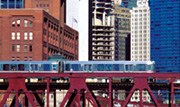
between downtown and the Northwest Side, the
Brown Line was originally constructed in |
|
|
 |
|
| the
late 1800s and early 1900s. The line is one of CTA's busiest
rail lines, serving more than 66,000 customers each weekday,
with 19 stations from Kimball on the north to the downtown
Chicago Loop. |
| The
line is one of CTA's busiest rail lines, serving
more than 66,000 customers each weekday. |
|
Since 1979, Brown Line ridership
has increased approximately 83 percent. Since 1998,
ridership has increased by 27 percent, which is
the highest rate of growth anywhere in CTA's rail
transportation system. All Brown Line stations presently
accommodate six- |
|
| car
trains with the exception of Merchandise Mart, Fullerton
and Belmont, which can berth eight-car trains. The Brown
Line is one of only two CTA rail lines that cannot fully
accommodate eight-car trains. The other line is the Purple
Line. |
|
Since the mid-1990s, CTA has made operational changes
to accommodate demand on the Brown Line, including having
Purple Line trains stop at Brown Line stations from Belmont
to downtown Chicago, extending service hours, adding additional
trips during afternoon rush hours, reducing headways and
restoring service on Sundays. Despite these service adjustments,
persistent crowding on Brown Line station platforms continues
to impact customers. |

|
|

 |
| As of
|
| |
|
|
|